
Where is the short-stem philosophy heading?
Hip arthroplasty has changed significantly in recent years. Short-stem implants such as the Swiss-developed optimys stem are being used increasingly often. Calcar-guided total hip arthroplasty deserves particular attention because it enables individualized solutions, as Prof. Karl Philipp Kutzner of Mainz explains in this interview.
Professor Kutzner, you have been working on calcar-guided short-stem total hip arthroplasty for many years. What prompted you to focus on this area so intensively back then?
It began with the observation that conventional short stems offer clear advantages, but each also has specific limitations. During preoperative planning, for example, it repeatedly became apparent that an implant might fit one patient’s anatomy very well, but not the next. Sometimes we planned with up to five different implants and realized that none of them fit equally well in every case. The development of a calcar-guided design, like optimys, arose from the desire to overcome these limitations. The curvature along the femoral calcar was initially a design feature. Only later did it become clear that it formed the basis for a variable, patient-specific implantation strategy.
What problems were short-stems originally intended to solve?
Long, diaphyseal-anchored stems are associated over time with well-known disadvantages, such as increased bone loss in the proximal femur. Short stems were originally intended to reduce these stresses and enable a more bone-preserving approach. They were therefore first conceived as a way to mitigate the biomechanical disadvantages of long stems. However, the calcar-guided variant went far beyond that. The actual concept is individualized fixation. optimys, for example, is a calcar-guided short stems and follows the femoral calcar along a curved implantation path, allowing the surgeon to adapt the reconstruction more precisely to the patient’s natural anatomy. This can support physiological load transfer, preserve bone and soft tissue, and contribute to a more personalized approach to hip replacement.
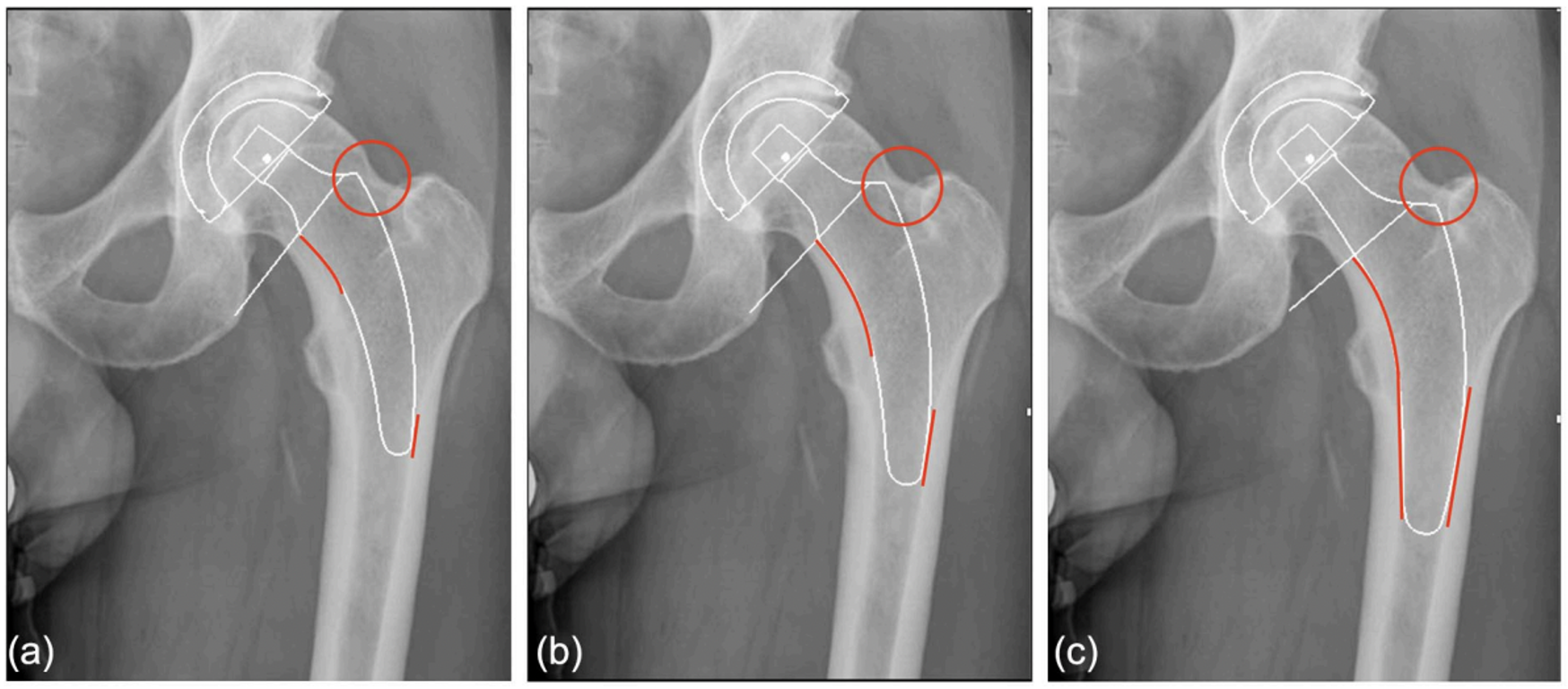 Different preoperative templating strategies in the identical patient (a) High osteotomy, varus alignment, shoulder superior to fossa, lateral point load (b) Intermediate osteotomy, varus or neutral alignment, same-level to fossa, lateral area load (c) Low osteotomy, neutral or valgus alignment, shoulder inferior to fossa, distal fit-and-fill.
You introduced a new classification. Why was a new classification system for calcar-guided short stems necessary?
I considered a new classification necessary because the same calcar-guided short stem can behave very differently depending on the anatomy, level of osteotomy, alignment, bone quality, and implantation strategy. Short-stem arthroplasty should not be understood as a single, uniform philosophy. Rather, it represents a spectrum of individualized fixation strategies. The classification therefore focuses less on implant design alone and more on fixation behavior and anchoring concepts.
Particularly for surgeons who are new to the technique, the classification serves as a decision-making aid. It clearly categorizes patient groups, bone quality and anatomical features, and prevents incorrect application. This can make hip arthroplasty more flexible, safer and more precise.
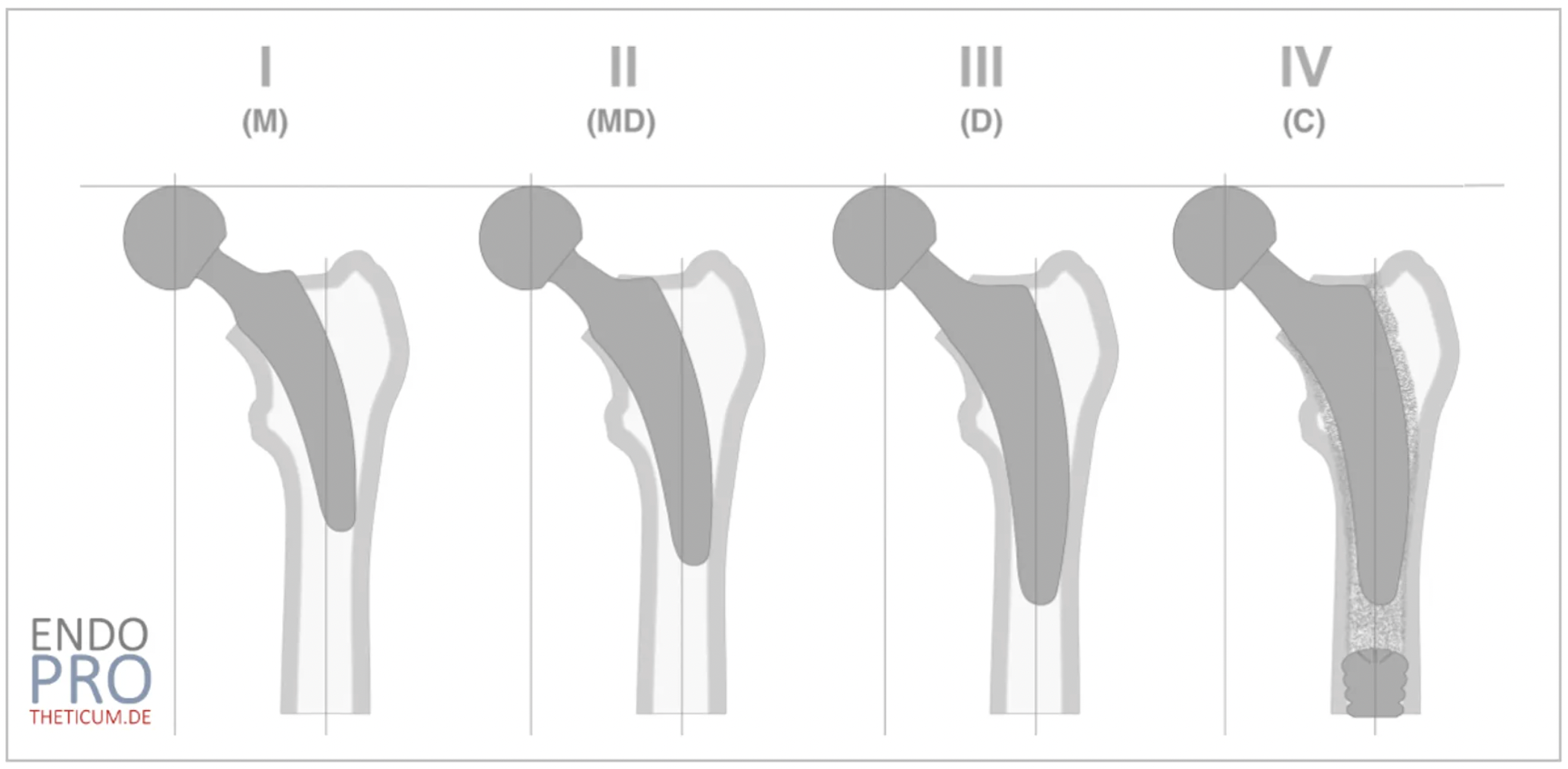
Classification system in calcar-guided ssTHA (a) Type I (M), metaphyseal anchorage (b) Type II (MD), meta-diaphyseal anchorage (c) Type III (D), diaphyseal anchorage (d) Type IV (C), cemented fixation.
What does the Kutzner classification describe in practical application?
The classification distinguishes four fixation concepts:1
-
Group I describes purely metaphyseal fixation with very proximal load transfer and maximal bone preservation.
-
Group II refers to meta-diaphyseal fixation, combining metaphyseal anchorage with increased rotational stability and broader cortical support.
-
Group III describes more distal, diaphyseal fixation patterns that can be helpful in demanding anatomy or reduced bone quality.
-
Group IV comprises cemented fixation concepts that can extend this philosophy to older patients or selected cases with osteoporotic bone.
Taken together, these groups show that the same stem design can enable very different biomechanical solutions.
In this context, you speak of a paradigm shift. What exactly is changing?
Individualization begins even before surgery. Factors such as age, sex, bone quality, anatomical variation, and diagnosis all play a role in planning. I ask myself: What is the best approach in this case? How do I want to treat this patient? While many clinics around the world still follow a standardized approach, the calcar-guided philosophy allows surgeons to choose the fixation concept according to the individual situation while using the same implant.
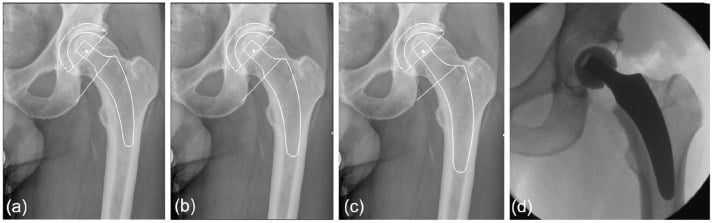 Case of a 62-year-old man with left hip pain (a–c). Preoperative templating of different fixation strategies according to the present classification (d). Intraoperative radiograph shows a type I (M) procedure.
Are there any patient groups that particularly benefit from a short-stem total hip arthroplasty?
Originally, short-stem hip arthroplasty was intended for young, active patients with good bone quality. Today, however, it has become clear that, with an adapted technique, it can also work reliably in older patients with reduced bone quality. Only in extreme situations, such as severe osteoporosis or multiple previous operations without a preserved femoral neck, are other stem types required.
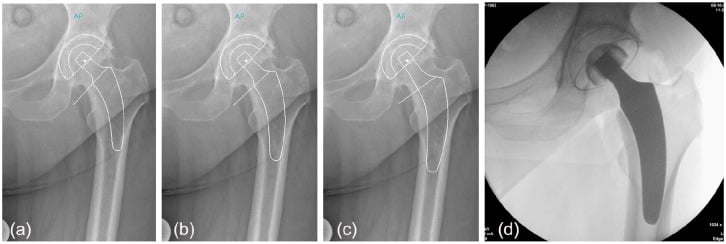 Case of a 74-year-old woman with left hip pain (a–c). Preoperative templating of different fixation strategies according to the present classification (d). Intraoperative radiograph shows a type II (MD) procedure.
What role do minimally invasive approaches play?
Calcar-guided short stems like optimys are particularly well suited to tissue-sparing surgical techniques because their reduced length and curved geometry facilitate implantation through muscle-sparing approaches. This fits very well with the growing interest in minimally invasive surgery, outpatient arthroplasty, and accelerated rehabilitation. Today, success is no longer defined solely by implant survival. Bone preservation, soft-tissue protection, physiological biomechanics, and the speed of recovery are also becoming increasingly important.
Why is the short-stem philosophy, with its individualized treatment options, hardly widespread in the U.S.?
So far, optimys has not yet received approval in the U.S.. Yet without a suitable implant, the corresponding treatment philosophy remains largely unknown. Approval is expected in the coming years, and interest in calcar-guided short stems in the U.S. is then likely to increase significantly. Colleagues there can benefit from the European experience. Registry data for optimys from Germany and Switzerland show very low failure and complication rates over a period of more than ten years. Although ten years do not yet constitute “true” long-term data, the results indicate a high level of long-term durability.
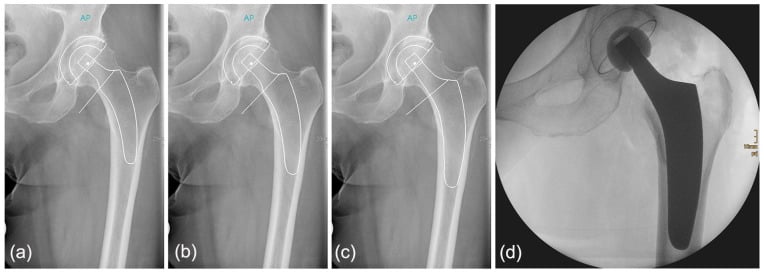 Case of an 88-year-old woman with left hip pain (a–c). Preoperative templating of different fixation strategies according to the present classification (d). Intraoperative radiograph shows a type III (D) procedure.
A look into the future: What do you think hip replacement surgery will look like in 10 to 15 years?
I expect calcar-guided short-stem hip arthroplasty to become the international standard. At the same time, a second trend could gain importance: ceramic surface replacement, in other words, a bone-preserving resurfacing of the femoral head. Advances in ceramic technology are making this concept increasingly realistic.
Calcar-guided short-stem hip arthroplasty shows just how far individualized hip arthroplasty has already come. A single implant that can be used in very different ways depending on the patient group and bone quality – that is the essence of the paradigm shift. While Europe is already shaping this development, the U.S. is only just beginning. With the expected approval, however, that could change rapidly.
Prof. Dr. med. Karl Philipp Kutzner is a board-certified specialist in orthopedics and trauma surgery and a specialist in hip and knee arthroplasty at the Endoprotheticum Rhein-Main in Mainz. From the start of his career as a specialist in endoprosthetics, he has worked with short-stem total hip arthroplasty and prefers - whenever possible - this implant philosophy. He contributes his expertise to education and training: For example, he regularly serves as the scientific director of continuing education courses organized by the AE – German Society for Endoprosthetics e. V.
Reference:
1 Kutzner KP. Same same but different: Introduction of a classification system in calcar-guided short-stem total hip arthroplasty. Hip Int. 2024 Nov 25;35(1):54–61; https://pmc.ncbi.nlm.nih.gov/articles/PMC11667953/ [last accessed 16.06.2026]